Control Flow in Python and Lisp
Let's look at control flow in Python and in Lisp. By control flow we understand the order in which statements and expressions are executed. In imperative programming, control flow is explicit while in declarative programming and logic programming it is implicit.
Sequencing
In Python statements are executed one after another.
def foo(n):
    x = n + 1
    y = x + 2
    z = 3 + 4
In Lisp the most common sequencing operator is progn. It evaluates each of
its arguments in turn and then returns the value(s) of the last one.
(progn (+ 3 4)
       (+ 5 6)
       (+ 7 8))
At high optimization settings a Lisp compiler might notice that the first two subexpressions are superfluous and remove them. However there are some cases where subexpressions have side-effects.
(progn (print (+ 3 4))
       (print (+ 5 6))
       (+ 7 8))
Many forms have an implicit progn, for example defun
(defun foo (n)
  (+ 3 n)
  (+ 5 n)
  (+ 7 n))
As well as progn, there are prog1 and prog2 which return the value of
their first and second subexpression, respectively.
Conditionals
if
In Python conditional branching is done with the if statement
from math import sqrt


def sqrty(x):
    if x < 0:
        return sqrt(-x)
    else:
        return sqrt(x)

sqrty(-4)
2.0
Python also has a one-legged if
def foo(x):
    if x < 0:
        print("x is negative")


foo(-3)
x is negative
In Lisp if is not a statement but an expression: it returns a value
(let ((x -4))
  (+ 3 (if (< x 0)
           (sqrt (- x))
           (sqrt x))))
If can be used in a one-legged way in Lisp but it is not recommended. For
that purpose there is when. For the other leg there is unless
(let ((x -3))
  (if (< x 0)
      (print "x is negative"))

  (when (< x 0)
    (print "x is negative"))

  (unless (>= x 0)
    (print "x is negative")))
cond
For multi-branch conditionals in Python we have to use of an explicit if
… elif … elif … else construct. Here's a Python function that used to
be familiar to AUC students.
def auc_grade(percentage):
    """Takes a percentage and returns a letter grade following the
    AUC grading criteria."""
    if percentage >= 90:
        return "A+"
    elif percentage >= 82.5:
        return "A"
    elif percentage >= 77.5:
        return "A-"
    elif percentage >= 72.5:
        return "B+"
    elif percentage >= 69:
        return "B"
    elif percentage >= 66.5:
        return "B-"
    elif percentage >= 63.5:
        return "C+"
    elif percentage >= 58.5:
        return "C"
    elif percentage >= 55:
        return "C-"
    elif percentage >= 53:
        return "D+"
    elif percentage >= 51:
        return "D"
    elif percentage >= 45:
        return "D-"
    else:
        return "F"
In Lisp we have the cond construct. Each clause consists of a test followed
by a number of forms. If no test is triggered, then cond returns nil.
(defun auc-grade (p)
  (cond ((>= p 90 )  "A+")
        ((>= p 82.5) "A")
        ((>= p 77.5) "A-")
        ((>= p 72.5) "B+")
        ((>= p 69)   "B")
        ((>= p 66.5) "B-")
        ((>= p 63.5) "C+")
        ((>= p 58.5) "C")
        ((>= p 55)   "C-")
        ((>= p 53)   "D+")
        ((>= p 51)   "D")
        ((>= p 45)   "D-")
        (t           "F")))
If you macroexpand the cond form, you can see it expands into a "staircase"
of if statements.
The forms following the test are wrapped in an implicit progn if there is
more than one.
(defun auc-grade (p)
  (cond ((>= p 90 )  (print "Well done") "A+")
        ((>= p 82.5) "A")
        ((>= p 77.5) "A-")
        ((>= p 72.5) "B+")
        ((>= p 69)   "B")
        ((>= p 66.5) "B-")
        ((>= p 63.5) "C+")
        ((>= p 58.5) "C")
        ((>= p 55)   "C-")
        ((>= p 53)   "D+")
        ((>= p 51)   "D")
        ((>= p 45)   "D-")
        (t           (print "Ouch!") "F")))
case
Lisp also has a case statement. Here is an example adapted from CLHS.
(dolist (k '(1 2 3 :four #\v () t 'other))
  (format t "~6S ~6S~%" k
          (case k
            (1          'clause1)
            ((2 3)      'clause2)
            ((:four #\v) 'clause4)
            (nil         'no-keys-so-never-seen)
            ((nil)       'nilslot)
            ((t)         'tslot)
            (otherwise   'others))))
As well as case, there are ccase and ecase. They signal a correctable
and a non-correctable error respectively if no normal clause matches. Again,
an example from CLHS.
(defun decode (x)
  (ccase x
    ((i un) 1)
    ((ii dos) 2)
    ((iii tres) 3)
    ((iv cuatro) 4)))

(decode 'iiii)
Recursion and Iteration
Any general purpose programming language must facilitate repeating an operation on or for looping over structures or a sequence of values. Let's first look at Python.
Iteration in Python
Python's for statement is usually used to iterate over a structure, such as a
list or set, or sequence of values, for example expressed as a range.
for x in [1, 2, 4]:
    print(x * x)

for x in {1, 2, 4}:
    print(x * x)

for x in range(1, 7, 2):
    print(x * x)
1
4
16
1
4
16
1
9
25
We can make further iterables using generator expressions.
squares = (x * x for x in range(4))

for s in squares:
    print(s)
0
1
4
9
More generally we can make generators using the yield statement.
def squares_from(n):
    yield n * n
    n += 1
    yield n * n
    n += 1
    yield n * n


for s in squares_from(5):
    print(s)
25
36
49
This allows us to go even further and make infinite generators. Note that we have to be careful how we iterate over such a generator.
def squares_from(n):
    while True:
        yield n * n
        n += 1


for s in squares_from(5):
    if s > 100:
        break
    print(s)
25
36
49
64
81
100
Pace such cases, we can say that usually Python's for statement is for
iterating over structures when we know their size before starting the
iteration. For this reason we call it structural iteration.
More generally, for full Turing completeness, we need a kind of iteration which
is not merely structural but which depends on an arbitrary Boolean expression.
In Python we use the while statement.
Here is an example of using a while loop for generatively finding a root of
the function \(sin(1/x)\) using Newton's method.
from numpy import linspace, sin, cos
import matplotlib.pyplot as plt

plt.style.use("classic")


def f(x):
    return sin(1 / x)


def df(x):
    return -cos(1 / x) / x**2


def newton(x, epsilon = 1e-3):
    while abs(f(x)) > epsilon:
        x = x - f(x) / df(x)
        print(f"{x:12.4f} {f(x):012.10f}")
    return x


xs = linspace(0.01, 0.1, 100)
plt.plot(xs, f(xs))
plt.savefig("sineinv.png")
# plt.show()
<Figure size 640x480 with 1 Axes>
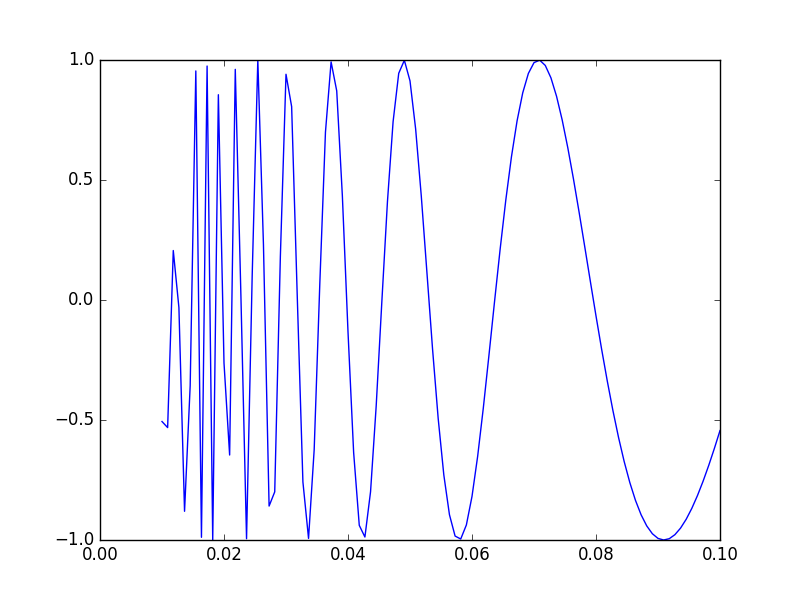
The important thing to note here is that we do not generally know in advance
how many times we will loop through the while. We will usually have an
argument about convergence and termination that gives us confidence that it
will indeed stop and hopefully within a reasonable time. We call this kind of
iteration generatice iteration.
Recursion in Python
Now how about recursion in Python. We can write recursive functions like this.
It's not the most efficient way to add up the first n integers but bear with me.
def sum_n(n, acc=0):
    if n == 0:
        return acc
    else:
        return sum_n(n - 1, n + acc)
This works fine for "reasonable" values of n but it gets to a point where
Python throws in the towel.
sum_n(3001)
---------------------------------------------------------------------------
RecursionError                            Traceback (most recent call last)
Cell In[11], line 1
----> 1 sum_n(3001)

Cell In[10], line 5, in sum_n(n, acc)
      3     return acc
      4 else:
----> 5     return sum_n(n - 1, n + acc)

Cell In[10], line 5, in sum_n(n, acc)
      3     return acc
      4 else:
----> 5     return sum_n(n - 1, n + acc)

    [... skipping similar frames: sum_n at line 5 (2975 times)]

Cell In[10], line 5, in sum_n(n, acc)
      3     return acc
      4 else:
----> 5     return sum_n(n - 1, n + acc)

RecursionError: maximum recursion depth exceeded
Python has a limit to how deeply you may make recursive calls. By default it is
3000.
import sys

print(sys.getrecursionlimit())
3000
We can set it to be a higher value but there is always going to be a limit. Python thinks that if you make that many recursive calls, you can't possible mean to do so. You must be in an infinite loop and Python should protect you from yourself.
So although you can do shallow recursion in Python, Python does not lend itself to this style of programming. It is at heart a language that prefers that you use iteration and encourages you to do so.
Recursion in Lisp
Now how about Lisp? Lisp does lend itself to recursion. It provides a welcoming environment for you to use recursion provided you do so with care.
(defun sum-n (n)
  (if (zerop n)
      0
      (+ n (sum-n (1- n)))))

(defun sum-n-acc (n &optional (acc 0))
  (declare (optimize (speed 3))
           (fixnum n acc))
  (if (zerop n)
      acc
      (sum-n-acc (1- n) (+ n acc))))
Here there is no recursion limit but we do have to encourage our Lisp compiler
to compile this code efficiently. When we do so, the sbcl compiler performs
Tail Call Optimization (TCO). This effectively eliminates the cost of the
recursive function calls and makes recursion as efficient as iteration.
Most modern Common Lisp Implementations perform TCO but it didn't arrive to Python until 2025!
- Recursion over lists, natural numbers and trees
- Lists
How can you make a list? There are many ways but they all boil down to two. You can make an empty list with
nilor()or you canconssomething onto an existing list. Here are some examples. Let's consider lists of integers.() (cons 3 ()) (cons 4 '(5 6 7)) (cons 8 (cons 9 ()))
We say that the type list has two constructors
niland(). Corresponding to each constructor areaccessorswhich access the values which had been given to the constructor. Thenilconstructor takes no values and as such has no accessors. Theconsconstructor takes two values, a number and a list of numbers and, as such, has two accessors known asfirstandrestor alternatively ascarandcdr. It only makes senst to applyfirstandrestto a list that was made bycons. Applying them toniljust givesnil.(first (cons 3 ())) (first (cons 4 '(5 6 7))) (first (cons 8 (cons 9 ()))) (rest (cons 3 ())) (rest (cons 4 '(5 6 7))) (rest (cons 8 (cons 9 ())))
So when we ask ourselves what is a list? We say it's either
the empty list
'()ornil. It satisfiesnull(null '()) => T (null nil) => T (null t) => NIL (null 1) => NIL
a list with something in it, thus made (directly or indirectly) using
cons. It satisfiesconsp(consp nil) => false (consp (cons 1 2)) => true (consp (list 1 2 3 4)) => true
Note that a proper lisp is made with a number of occurrences of
consand terminated bynil
(list 1 2 3 4) ≡ (cons 1 (cons 2 (cons 3 (cons 4 nil))))
An improper list (sometimes called a dotted list) is terminated by anything but
nil.(cons 1 2)) => (1 . 2)
In this section we will work only with proper lists.
With all of this in mind, let's now write a recursive function that operates on a list of numbers. The function
lengthexists already but let's write our own version.We begin with a template
(defun my-length (ns)
  ...)
Before we go any further, let us write down our expectations of how
my-lengthshould work. Later we will learn how to write structured unit tests but for now let's just write some Lisp expressions that we expect to be true.(and (= 0 (my-length ())) (= 1 (my-length (list 9))) (= 2 (my-length (list 9 8))) (= 3 (my-length (list 9 8 7))))
After we have prepared our definition of
my-length, we can run the above expression and expect it to return true.Returning to our template,
nsis a list of numbers so what can it be? It can be eithernilor acons. Let's distinguish.(defun my-length (ns) (cond ((null ns) ...) ((consp ns) ...)))
If the list is null then the length must be zero.
(defun my-length (ns)
  (cond ((null ns) 0)
        ((consp ns) ...)))
If the list is a
consthen we must be able to access its values.(defun my-length (ns) (cond ((null ns) 0) ((consp ns) ... (first ns) ... ... (rest ns) ...)))
Now we remind ourselves what the types are of those two values. The value
(first ns)must be a number. The value(rest ns)must be a list of numbers. Since it is a list of numbers it is something that we can give as input tomy-length. Let's do that.(defun my-length (ns) (cond ((null ns) 0) ((consp ns) ... (first ns) ... ... (my-length (rest ns)) ...)))
Applying
my-lengthto(rest ns)is such a natural thing to do, we call this the natural recursion.We ask ourselves what are they types of these expressions?
nsis a list of numbers so(first ns)must be a number. And we expectmy-lengthto return a number so(my-length (rest ns))must be a number. But which number is it? It is the length ofnsafter taking one element away from it. So if we add1to it we get the length ofns, which is what we want!(defun my-length (ns) (cond ((null ns) 0) ((consp ns) (1+ (my-length (rest ns))))))
Note that we have discarded the value
(first ns). We don't need it. This makes sense since we don't actually care what is in the list, just how many things are there.Does it work? Try it out by evaluating our test expression. Yes it does. It is a recursive function on lists.
Try for yourself to use this method to write these functions on lists of numbers:
- Find the largest number in the list.
- Find the sum of all numbers in the list.
- Return the list with elements which are double those of the input list.
- Natural numbers
These are the natural numbers (ℕ), also known as the counting numbers
0, 1, 2, 3, ...
Similarly to lists, we could say that a natural number is either
0, which satisfieszerop, or(zerop 0) => t (zerop 3) => nil
- a positive number, which satisfies
plusp
(plusp 0) => nil
(plusp 3) => t
- a positive number, which satisfies
In fact the axiomatic basis for arithmetic on the natural numbers, called the Peano axioms, define the natural numbers in this way.
0is a natural number.- For every natural number
n, its successors(n)is a natural number. - There are no other natural numbers.
If we have a number
nand we are sure that it satisfies(plusp n)then we can take its predecessor (and be sure that the predecessor is a natural number).(defvar n 3) (plusp n) ; => t (1- n) ; => 2
Note that we cannot do this if
n=0since its predecessor is no longe a natural number.Let's define a function that takes a natural number
nand sums all natural numbers up to and includingn.(defun sum-to (n) ...)
As previously, let us write an expression that expresses our expectations about
sum-to.(defun test-sum-to () (and (= 0 (sum-to 0)) (= 1 (sum-to 1)) (= 3 (sum-to 2)) (= 6 (sum-to 3))))
Now, returning to the template, what can
nbe? It can be either zero or positive. Let's distinguish.(defun sum-to (n) (cond ((zerop n) ...) ((plusp n) ...)))
If
nis zero then we know that the result should be zero.(defun sum-to (n) (cond ((zerop n) 0) ((plusp n) ...)))
And if
nis positive then we know that we can take its predecessor.(defun sum-to (n) (cond ((zerop n) 0) ((plusp n) ... (1- n) ...)))
Furthermore we know that the predecessor
(1- n)is a natural number so it is something that we can give to the functionsum-to(defun sum-to (n) (cond ((zerop n) 0) ((plusp n) ... (sum-to (1- n)) ...)))
Again, this is the natural recursion.
What would the value of
(sum-to (1- n))be? Well it's just the sum of all natural numbers up ton-1. And if we know that then all we need to do is addnto it to get the result we want.(defun sum-to (n) (cond ((zerop n) 0) ((plusp n) (+ n (sum-to (1- n))))))
We check our test expression and see that it holds.
Now use this method to write functions to
- Sum all the squares of numbers up to and including
n - Sum all odd numbers up to and including
n. (You can use the functionoddp) - Common Lisp has the functions
oddpandevenpbut let's write our own. Call themmyoddpandmyevenp. The functions should depend on each other by calling on each other. This is called mutual recursion.
- Binary trees
Now we turn our attention to binary trees. We haven't yet talked about data abstraction but let's have a look at how we can define new data structures in Lisp.
(defstruct node
  (value  nil :type fixnum)
  (left   nil :type bt)
  (right  nil :type bt))

(deftype bt () '(or node null))
This defines two things. It defines
- a new data structure called
nodewhich has three slots. - a binary tree to be either
nilor anode
Note also how the two definitions are mutually recursive; each of them refers to the other. This means that any function we write which takes a
btwill need to refer to anodeand vice versa. Just like we did withmyoddpandmyevenp.The
defstructstatement actually defines five new functions for us!- A constructor function
make-node - Three accessor functions
node-value,node-leftandnode-right, one for each of the three slots of the structure - A predicate to recognise a
nodecallednode-p
(make-node :value 3)

(node-value (make-node :value 3))

(make-node :left (make-node :value 2)
           :value 3
           :right (make-node :value 4))

(node-left (make-node :left (make-node :value 2)
                      :value 3
                      :right (make-node :value 4)))

(node-value (node-left (make-node :left (make-node :value 2)
                                  :value 3
                                  :right (make-node :value 4))))

(node-p (make-node :left (make-node :value 2)
                   :value 3
                   :right (make-node :value 4)))
Note that when no value is given to a slot, such as
:leftand:rightin(make-node :value 4), their values default tonil.Let's write a recursive function which adds up all the numbers in a binary tree. We begin with a template.
(defun sum-bt (bt)
  ...)
(and (= 0 (sum-bt ()))
     (= 3 (sum-bt (make-node :value 3)))
     (= 9 (sum-bt (make-node :left (make-node :value 2)
                             :value 3
                             :right (make-node :value 4)))))
Returning to our template, what can
btbe? We refer to our definition. It is eithernilor anode. Let's distinguish.(defun sum-bt (bt) (cond ((null bt) ...) ((node-p bt) ...)))
If
btis null then the sum must be zero.(defun sum-bt (bt) (cond ((null bt) 0) ((node-p bt) ...)))
If
btis a node then we can access its values. The structure has three accessors.(defun sum-bt (bt) (cond ((null bt) 0) ((node-p bt) ... (node-left bt)... ... (node-value bt)... ... (node-right bt)... )))
The types of these values are binary tree, integer and binary tree. Since two of these values are binary tree, we can use natural recursion and apply our function
sum-btto them.(defun sum-bt (bt) (cond ((null bt) 0) ((node-p bt) ... (sum-bt (node-left bt))... ... (node-value bt)... ... (sum-bt (node-right bt))... )))
Now let's ask ourselves what the result is of
(sum-bt (node-left bt))? It is the sum of all of the nodes in the left child ofbt. We also have the sum of all of the nodes in the right child ofbt. And(node-value bt)is the number at this node. If we add up those three values, we're done!(defun sum-bt (bt) (cond ((null bt) 0) ((node-p bt) (+ (sum-bt (node-left bt)) (node-value bt) (sum-bt (node-right bt))))))
A few years ago there was a discussion on Hacker News. Someone applied for a job at Google and one of the questions he was asked was to "invert a binary tree". He didn't even know what that was. There was outrage because it turned out that he had written a piece of open-source software that was apparently used by 90% of engineers at Google.
Whatever you may think of the discussion, if you apply the approach we sketch above you can quickly define the function.
Write the function
invert-btthat takes a binary tree and returns the binary tree that is its mirror image through a vertical axis. - a new data structure called
- Lists
- Recursion over s-expressions
An s-expression is any lisp expression that satisfies either
atomorconsp. In other words all atomic values and all values constructed bycons. An example of an s-expression is:(1 2 3 (a b c) "def" 3.141592 ((((99)))))
- Write some more examples of s-expressions.
- Write a function
sexp-pwhich determines whether a Lisp value is an s-expression. - Write a function which takes an s-expression and returns a list of all numbers occurring in it.
Iteration in Lisp
So how about iteration in Lisp? The Lisp language has a selection of operators
but I recommend that you use one unified approach that is provided by a
library. So let's use quicklisp to load it.
(ql:quickload :iterate)

(use-package :iterate)
The first of these loads the iterate library into your running Lisp image
(first downloading it if necessary). The second gives us access to the exported
functionality of the library.
Let's first look at a couple of uses which parallel Python's for statement.
(iter (for n in '(1 2 3 4))
      (print n))
You can collect values into a list.
(iter (for n in '(1 2 3 4))
      (collect (* n n)))
Or into a vector
(iter (for n in '(1 2 3 4))
      (collect (* n n) result-type 'vector))
You can generate sequences of numbers in many ways.
(for i upfrom 0) => 0 1 2 ...
(for i from 5) => 5 6 7 ...    ; either from or upfrom is okay
(for i downfrom 0) => 0 -1 -2 ...
(for i from 1 to 3) => 1 2 3
(for i from 1 below 3) => 1 2
(for i from 1 to 13 by 2) => 1 3 5 7 9 11 13
(for i from 1 below 13 by 2) => 1 3 5 7 9 11
(for i from 5 downto 3) => 5 4 3
You can iterate over vectors.
(iter (for i in-vector #(2 3 4 5))
      (summing i))
Or over the lines (or chars or bytes) of a file.
(iter (for line in-file "control-flow.org" using #'read-line)
      (summing (length line)))
(iter (for char in-file "control-flow.org" using #'read-char)
      (count char))
You can do mapping.
(iter (for x in '(1 2 3 4))
      (collect (* x x)))
You can do filtering and accumulation.
(iter (for i below 100)
      (when (evenp i)
        (sum i)))
You can deconstruct values
(iter (for (a b c) in '((1 2 3) (4 5 6) (7 8 9) (10 11 12)))
      (when (evenp a)
        (sum b)))
And you can do complex combinations.
(let ((ns (iter (for i below 100)
                (collect (random 1000)))))
  (iter (for i in ns)
        (counting (evenp i) into evens)
        (counting (oddp i) into odds)
        (summing i into total)
        (maximizing i into max)
        (minimizing i into min)
        (finally (format t "Min: ~a~%Max: ~a~%Total: ~a~%Evens: ~a~%Odds: ~a~%"
                         min max total evens odds))))
Furthermore, iterate can be extended by adding new clauses. This example defines a specific reduction where the initial value gets divided in turn by each of the values in the list.
(defmacro dividing-by (num &key initial-value)
  `(reducing ,num by #'/ initial-value ,initial-value))

(iter (for i in '(5 5 2))
      (dividing-by i :initial-value 100))
Other iteration forms
In Lisp code you will also see dotimes and dolist for iterating over
counting numbers and lists.
(dotimes (i 4) (print i))
(dolist (x '(do re me)) (print x))
There is also a more general form of iteration called do. Here is an example.
- There are two variables to iterate over,
xandy. - Each variable has an initialization expression:
xhas100andyhas0. - Each variable has an update expression:
xgets decremented whileygets incremented. - There is an end test, in this case when
ybecomes greater thanx. - There is a return expression, in this case a list containing
xand=y=
(do ((x 100 (1- x))
     (y 0   (1+ y)))
    ((> y x) (list x y)))
(49 51)
- Loop
Loop is a general looping facility to which an entire chapter in the Common Lisp HyperSpec is dedicated. Peter Seibel also dedicates the chapter LOOP for Black Belts to it in his book Practical Common Lisp. Here's an example from that chapter.
(loop for i from 1 to 100
      if (evenp i)
        minimize i into min-even and
      maximize i into max-even and
      unless (zerop (mod i 4))
        sum i into even-not-fours-total
      end
      and sum i into even-total
      else
        minimize i into min-odd and
      maximize i into max-odd and
      when (zerop (mod i 5))
        sum i into fives-total
      end
      and sum i into odd-total
      do (update-analysis min-even
                          max-even
                          min-odd
                          max-odd
                          even-total
                          odd-total
                          fives-total
                          even-not-fours-total))
As you can see,
loopprovides a mini-language for defining looping and iteration. However the mini-language is not at all lisp-like. In response to this Jonathan Amsterdam wrote the Iterate package which is similar toloopbut does have a lisp-like mini-language, extends the Loop functionality in several ways and is (macro) extensible. He describes his motivation in Don't Loop, IterateOpinions vary on the pros and cons of using
loopanditerate. Comparisons of the two can be found here and in Loop v Iterate. And while I'm not quite a knee-jerk anti-loopist, I am firmly in theiteratecamp so we'll be using it throughout. Once you become familiar withiterate, you will find that you can readily read code you might find which containsloopexpressions.You can find some examples of using
iterate(and indeedloopand others) in the chapter on iteration in the CL Cookbook.